
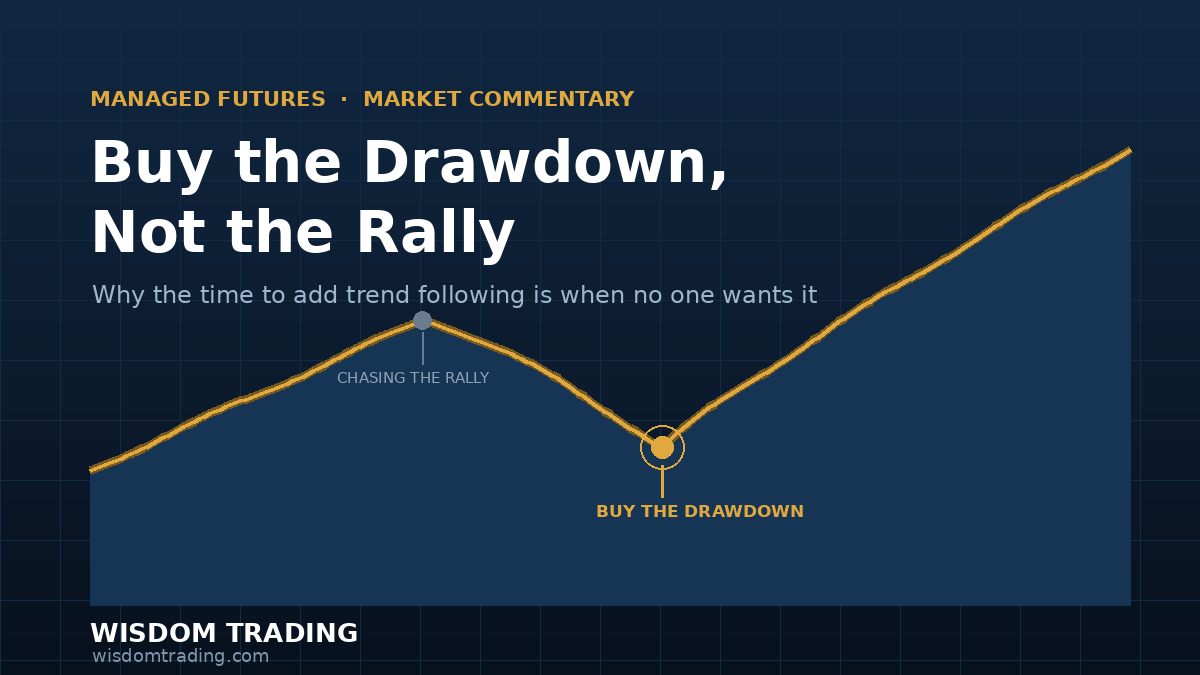
There is a predictable rhythm to how investors allocate to managed futures, and it runs almost exactly backwards. Money pours in after a banner year — when trend following has just printed double-digit returns and sits at the top of every allocator’s wish list — and it drains back out during the long, quiet drawdowns that inevitably follow. Buy high, sell low, repeat.
The disciplined approach is the opposite: add to trend following when it is out of favor and in a drawdown, not right after it has delivered. That is less satisfying and far less popular. It is also, historically, where the better entries have been made — and with an unusually full lineup of potential catalysts on the horizon, it is worth considering now.
The most expensive instinct in investing
Performance-chasing is the most well-documented mistake in all of asset allocation, and managed futures is no exception. The textbook example is 2022: trend following had an exceptional year as stocks and bonds fell together, and capital flooded in afterward — much of it arriving just in time for the choppier, range-bound stretch that came next. Investors who chased the 2022 numbers bought near a peak in the strategy’s recent performance and then had to sit through the give-back. The ones who had already allocated, when trend was unloved, captured the move.
Why trend following punishes return-chasers
Every strategy suffers when investors chase it, but trend following is unusually unkind to the practice, for a structural reason: its returns are lumpy and mean-reverting. Long, frustrating, flat-to-negative stretches are punctuated by a handful of large, concentrated gains when markets finally break into sustained trends. That profile means recent performance tells you very little about forward performance. If anything, a strong recent run raises the odds of a subsequent drawdown, and a painful drawdown raises the odds of a recovery. Timing your entry by chasing the strategy’s performance is, quite literally, a losing approach.
The drawdown is the feature, not the bug
Trend-following programs go through 15–25% drawdowns as a normal feature of the strategy, not a breakdown. Those drawdowns are the price of admission for the long-run record — and they are also the strategy’s best entry points. Adding during a drawdown does two things at once: it improves your cost basis on the strategy, and, just as importantly, it gets the allocation in place and correctly sized before the next dislocation, so you are positioned to participate rather than scrambling to chase the move after it is already underway.
Why now: the case for event risk
Trend following has historically been one of the few reliable sources of “crisis alpha” — the tendency to perform precisely when traditional portfolios are under stress and markets are moving in sustained, one-directional ways. That makes the current backdrop worth attention, because the list of potential catalysts over the next 6–18 months is unusually full:
- Geopolitical fragility. The recent Middle East conflict and its uneasy resolution showed how quickly oil, interest rates, and currencies can move on a single headline — and regional stability is far from assured.
- A developing El Niño. NOAA forecasts a high probability of El Niño emerging through mid-2026 and strengthening to moderate-or-strong levels by the winter of 2026–27. El Niño events have historically driven large, sustained moves across agricultural commodities — grains, coffee, cocoa, sugar — and shifted energy demand, exactly the kind of weather-driven dislocations trend systems are built to capture.
- Natural-disaster and hurricane-season risk. Supply shocks in energy and agriculture from major weather events tend to produce the clean directional moves that reward a diversified trend portfolio.
- Macro and policy uncertainty. Shifting central-bank guidance and an unsettled inflation picture continue to create breakouts across rates and currencies.
None of these is a prediction. The point is precisely that you cannot know which catalyst will fire, or when — which is the entire reason to hold a strategy that does not require you to. You want trend following already in the portfolio when the dislocation arrives, not added in a hurry once the move is obvious and half over.
This is allocation discipline, not market timing
To be clear, this is not a call to time the market or predict the next crisis. It is the opposite. Trend following is the instrument that lets you participate in large moves without forecasting them — but only if you are positioned in advance. The discipline is simple and unglamorous: size the allocation so you can survive the drawdowns, add when the strategy is quiet and unloved rather than after it has run, and let the system do the work. Buying the drawdown is how you make sure you are still there for the recovery.
What could go wrong
Honesty requires stating the other side. “Buying the dip” does not guarantee a near-term recovery — a drawdown can deepen or persist longer than expected, and there is no rule that the next catalyst arrives on your schedule. The potential events above may not materialize, or may resolve in choppy, whipsaw fashion that trend systems handle poorly. That is exactly why sizing and patience matter far more than precise timing: the goal is to hold a correctly-sized allocation through the full cycle, not to call the bottom.
How to put it to work
If you are evaluating a managed futures allocation, the worst time to start is right after a great year — and a quiet, unloved one is often the best. Learn how we build and size trend-following allocations on our trend following page, or request private manager recommendations, monthly reports, and the disclosure documents you won’t find advertised through The Managed Futures Insider. A principal responds within one business day.
This article is for informational and educational purposes only. It reflects the opinions of Comercio de Sabiduria and does not constitute investment advice or a recommendation to buy or sell any security, futures contract, or managed futures program. Managed futures are speculative, involve a substantial risk of loss, and are not suitable for all investors. Past performance is not necessarily indicative of future results.
Frequently asked questions
Isn’t buying the dip in trend following just market timing?
No — it’s the opposite. Market timing tries to predict the next move; trend following is designed to participate in large moves without predicting them. “Buying the drawdown” simply means adding a correctly-sized allocation when the strategy is quiet and out of favor, rather than chasing it after a banner year, so you are positioned in advance.
How large are trend-following drawdowns, and are they normal?
Trend programs typically experience 15–25% peak-to-trough drawdowns multiple times per decade, with occasional deeper ones. These are a normal feature of the strategy, not a malfunction — they are the price of admission for its long-run record, and historically they have also been among its better entry points.
Why would event risk like El Niño or geopolitical tension help trend following?
Trend following has historically been a source of “crisis alpha” — it tends to perform when markets move in sustained, one-directional ways, which is exactly what major dislocations produce. Weather events like El Niño can drive large moves in agricultural and energy markets, and geopolitical shocks can move oil, rates, and currencies; a diversified trend system is built to capture those moves wherever they appear.
When is the best time to start a trend-following allocation?
Often a quiet, unloved stretch rather than the period right after a strong year. What matters most is not precise timing but sizing the allocation so you can hold it through drawdowns, and giving it enough time to capture the lumpy, infrequent moves that drive its returns.